Iceland
2026-10-16
My first steps in Iceland were down a staircase from my 757 into the wind, rain and cold. My first lesson in Iceland was to always keep several layers ready.

I had planned this trip with Claude Code: three days of driving the south coast before heading to Reykjavík for MicroConf Europe. The plan was good, because Claude now knows how I like to organize my trips. That said, I think Iceland is the sort of place where, when the weather or the location suits you, you should feel free to break with the plan and enjoy it more, as I did several times.
Iceland gives you plenty of reasons to do that. It has a fascinating history and landscapes that look unfinished. It also puts its natural resources to work, and mostly that means the heat under the ground.

The first morning started with a smoked salmon sandwich at Kökulist, a bakery near the airport. Quite good. Then I drove straight to the lighthouses.

Garðskagaviti has two towers, an old one and a newer one, on a point where the surf comes in from every side. Someone's crab-pot float had washed up on the rocks with its flag still flying.


Reykjanesviti stands on a hill near the southwest tip of the peninsula. Once I crested the hill, the force of the wind was shockingly strong, and I was worried that a gust would blow me onto the lava field below. A short walk away, the cliffs of Valahnúkur drop into the surf. Steam from the Reykjanes Power Station drifts across the lava next door.

Driving north on Route 425, I pulled into a lay-by that wasn't on my plan. It holds Jupiter, one marker in The Planets on Reykjanes, a scale model of the solar system that the power company HS Orka built in 2008. The sun sits inside the power plant's grounds. From the same lay-by, a 170 m walk takes you to the Stampar crater row, and you're allowed to climb the crater nearest the road. The little picnic and parking areas along the highway are fantastic stops for taking in the views and occasionally finding a little gem like this.

Lunch was pizza from a geothermal oven at Ölverk, in Hveragerði. The beer was good, and the pizza was big enough that I skipped dinner.
That evening the Lava Centre in Hvolsvöllur explained what I had been driving over all day: the result of an intersection between a magma plume and the fault line between two tectonic plates. It's a small museum, but it illustrated the challenges of living in such a volcanically active place. It had video interviews with people forced to evacuate their homes because of a volcanic threat, which ultimately destroyed part of their town. There was also an interesting display showing the movement of various peaks over time, and seismic activity from all over Iceland. This place is seemingly always moving. Mountains move up and mountains move down, although I suppose they're really volcanoes. The smaller earthquakes aren't noticeable, but they seem almost continuous.
The next day was waterfalls. At Seljalandsfoss you can walk behind the water, so I did. Gljúfrabúi, a few minutes away, hides in a slot canyon you wade into. It was too crowded to get close, so Iceland owes me that one.

Skógafoss was the high point of the trip.

I climbed the steps beside it, and then I kept going. A trail follows the river upstream into the mountains, and from up there you can look back and see the coast, with the waves breaking in the distance.

That walk cost me two stops on the plan, Kvernufoss and the Skógar Museum. I was glad to spend the time in this beautiful outdoor environment, where I could see the coast, several volcanoes and an incredible glacier all in the same panorama.

Next came the plane wreck on Sólheimasandur, a US Navy transport that came down on the black sand in 1973. All seven crew survived. I walked out to it, which took about an hour, and rode the shuttle back. It was interesting, but I wouldn't go twice.

Lunch in Vík was a burger and a local beer at Smiðjan Brugghús.

Then Reynisfjara, the black beach known for sneaker waves. A sneaker wave is a wave much larger than the ones before it, and it can arrive without warning after 10 to 20 minutes of gentle surf. It can rush more than 150 feet up the beach, knock people off their feet and drag them into the ocean. At Reynisfjara, swells converge over a submerged ledge offshore, which makes these waves more likely. At least six people have died there since 2007, and the beach now has warning lights tied to a wave forecast.
The beach itself is interesting. Near the surf line it is sand. Farther up it turns to progressively larger pebbles, then stones, then larger boulders, as if the surf itself were sorting them by size as it slowly eroded the larger pieces into smaller ones. The basalt columns are the reason to go.
Walking along the beach, I noticed groups of people doing different things, some of them risky. People were climbing the basalt columns. Suddenly an Icelandic man started yelling, "Stop, stop, that is very dangerous! You must stop that!" Most of the beach looked around, trying to work out who he meant. He turned out to be some sort of beach patrol, and he walked up to a family who had been playing near the surf line. They got a long, loud lecture: this is the most dangerous beach in Iceland, stay back from the waves, many people die here. Nobody said a word to the climbers.

At Dyrhólaey there is a lighthouse, a rock arch and sea stacks, and on a clear evening you can see the Westman Islands to the west. I left too early. A sunset didn't look likely, but it got very dark very fast, and a few more minutes might have given me a better sky. On the drive out there were sheep on the road.

Dinner was at Berg, in Hótel Vík. A great meal.

On the third day I drove back toward Reykjavík. Knarrarósviti, a 1939 lighthouse and Iceland's first built of reinforced concrete, was a pleasant surprise. It stands between two Icelandic horse farms, and I'd go back just for the horses.


Kerið is a crater with a lake in it and a trail around the rim. It was an interesting hike, and it gave me good photos. I wasn't hungry after the hotel breakfast, so I skipped lunch, and that bought me time for a stop I hadn't planned.

The Geothermal Exhibition sits inside the Hellisheiði Power Station. It has volcanic stone samples, a turbine on display, a window into the generator hall, and a timeline of geothermal energy in Iceland. The timeline showed Icelanders going back and forth on hot springs, sometimes treating them as useful and sometimes as dangerous. Heating with them is newer than I expected. Two farmers piped hot water and steam into their farms in 1908 and 1911, and Reykjavík began heating buildings with it in 1930. The first geothermal power plant didn't open until 1969, and the oil crisis of 1973 pushed Iceland to build more. Today most of Hellisheiði's electricity goes to an aluminum smelter. It was a quick stop, and it deserved more time than I gave it.
In Reykjavík I returned the car and mostly walked. I had a list of museums, and I didn't visit one. The walking won.
The city's history surprised me as much as the geothermal history did. Iceland became a sovereign state in 1918, sharing a king with Denmark, and it became a republic in 1944, in the middle of World War II. The war changed Reykjavík. Britain occupied Iceland in May 1940, and American troops took over in 1941. The bases needed workers, and Icelanders moved to the capital for the jobs, which they called Bretavinna, "Brit work." The unemployment of the Depression years vanished. The Americans also built Keflavík Airport, where I landed.
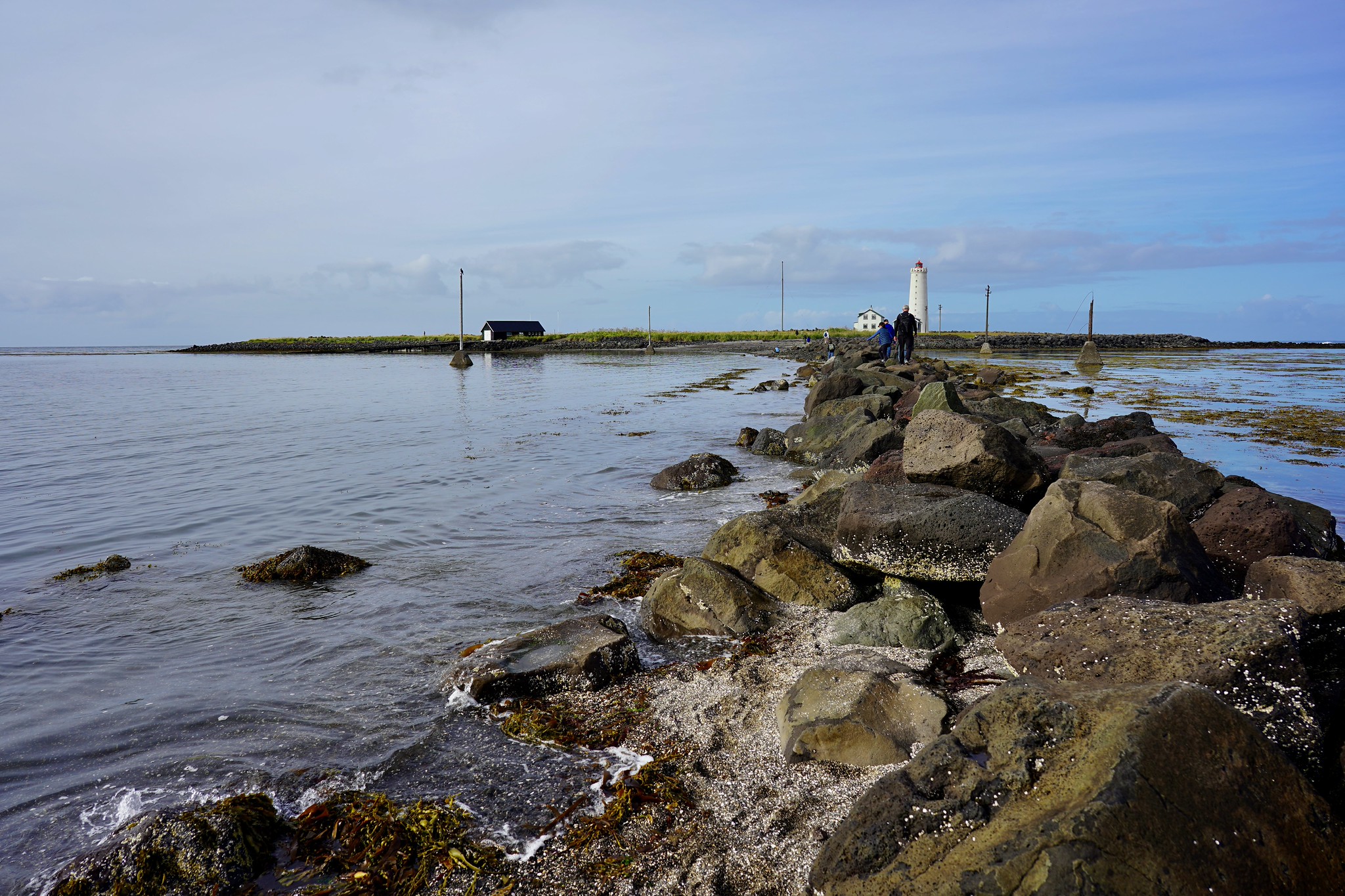
I walked out to Grótta, a lighthouse on a little island at the tip of the peninsula. I was led to believe that you couldn't get across during high tide, but that's exactly when I arrived. I made it across by clambering over the blocks. I'm not sure how often that works. Check the tide table, because the risk is getting stuck on the island for hours.

Afterward I had a small meal at Ráðagerði, an 1885 timber house with a real candle on every table. In this era of fake LED candles, the real ones surprised me, and they made for a unique atmosphere. The breakfast bruschetta was quite nice.

Back downtown, I walked out to Þúfa, a grass dome on the harbour with a spiral path to a fish-drying shed on top. Harpa is a beautiful building, and I saw most of it from the inside, because the conference was there. My notes from MicroConf Europe cover the talks.

The conference's excursion was a group hike to Reykjadalur, a hot-spring valley on the far side of a mountain from Hellisheiði. The trail is well defined but often muddy and steep. It isn't technical, but it is a good workout. The hot spring is really a stream running down the mountainside. It's a foot deep at most, and hot, at least in the 90s °F, depending on how far up the stream you go. The only amenities are a short wooden boardwalk and a few wooden privacy screens. Between the mud and the wind, you'll be a bit of a mess by the end. But the views are beautiful, the experience is unique, and you'll see at least one steam vent up close. Our guide warned us not to get too close: if you fell in, your socks would become your skin.
On the last morning I missed the Flybus to the airport. I was at the stop for my 6:30 departure, but other passengers said the bus had come early and left at 6:12. I waited until about 6:45, then called a taxi. It took a long time to arrive, cost a lot, and ended with a run through the airport. I made the flight. Apparently Flybus expects you to be at your stop at 6:00 AM for the 6:30 AM bus. That isn't a comfortable situation. You'll be standing outside in the wind, cold and rain, waiting for a bus at a stop with no shelter. I recommend either scheduling a taxi with Hopp or keeping your rental car, so you can guarantee yourself a less expensive ride to the airport. Unless you plan to stay in walkable Reykjavík, a rental car seems necessary in Iceland anyway.
Iceland still owes me a few things. I never saw the aurora. People at the conference who did see it took tours that drove them to wherever the clouds weren't, so next time I'll book one. I still want to stand inside Gljúfrabúi, and I still want to visit Viðey island. I'll plan for all of them, and leave room for whatever I find on the way.